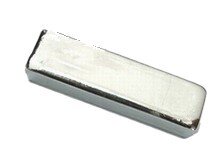

Indium 99.99% (In) – 1 gram
Indium, 99.99% purity, melting point 156.6 °C, weight 1 g.
Product code: IN-1G


Indium (In) is the softest of the non-alkaline metals. Like gallium, indium is also silvery white, visually similar to tin. Indium's melting point is higher than gallium's, but lower than lithium's or tin's. Indium is toxic; in nature, it occurs only in compounds.
-
Czech Indium, Latin Indium, English Indium
Fusible links, used for example to trigger automatic fire suppression systems, are made from an alloy of indium, gallium, bismuth, cadmium, lead, and tin.
The alloy of gallium, indium, and tin called Galinstan has a melting point of only -19 °C. It serves as a replacement for toxic mercury in medical devices and thermometers. Galinstan is also used for the production of single-crystal wafers.
Indium, applied in a thin layer on a flat surface, creates a very high-quality mirror surface, much more resistant to corrosion than classic silver mirrors. The advantage of indium mirrors is the reflectivity of the entire light spectrum. This makes them the highest quality mirrors.
Indium, like gallium, is part of light-emitting diodes (LEDs) and laser diodes, semiconductors and components, LCD displays, and touch screens. It also finds application in nuclear energy. Thanks to its high resistance to corrosion, it is used for electroplating bearings of aircraft engines. In the production of CD discs, a thin layer of indium is used to strengthen them.
Indium is a diamagnetic metal; it slightly weakens external magnetic fields and is weakly repelled by magnets.
Get indium with 99.99% purity.
Review
This product currently has no text reviews.
Information on how to get reviewsIndium, 99.99% purity, melting point 156.6 °C, weight 1 g.
Product code: IN-1G
Parameters
| Weight | 1 g |
| Material | Indium 99.99% |
Do you need advice on choosing?
Or do you need a larger quantity of magnets than is in stock?
Contact us. We will help you choose.